Long Lines
The Circum-Baikal Railway, Along Baikal’s Cliffs
An old Trans-Siberian lakeside section, about 38 tunnels, and Lake Baikal beside the track. The quieter branch is the point.
- Length
- about 89 km
- Usual time
- 1 day
- Travelled
- by train
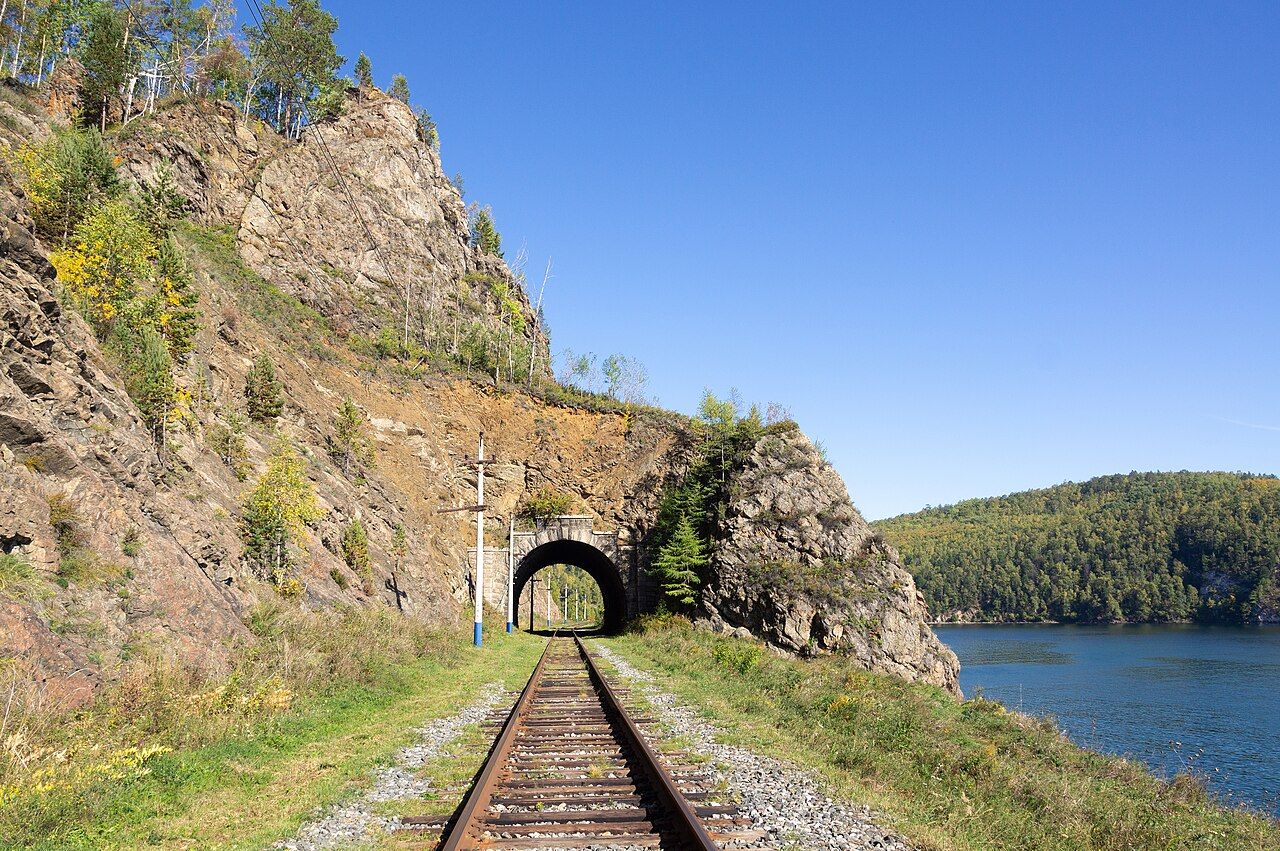
The lake holds the view; cliffs crowd the track. A train follows Lake Baikal's shore from Slyudyanka to Port Baikal. This is the Circum-Baikal Railway, and it rewards attention. The railway feels defined by its meeting of rock and water.
Completed in 1904 and 1905, it formed part of the line from Moscow eastwards. About 38 tunnels carry the railway through the lakeside cliffs. The tunnels make the railway's effort plain. Before completion, trains crossed Lake Baikal by ferry. Railway engineering here began with a crossing over water.
I like journeys where the engineering remains part of the view. That puts it beside the railway of a hundred tunnels and a canal dug by soldiers.
The numbers: about 89 km; 1 day; by train.
Lake Baikal is the deepest lake in the world, at about 1,642 m. UNESCO added Lake Baikal to its World Heritage list in 1996. The Angara is the only river that flows out of Lake Baikal. Those facts establish the scale; they are not the whole appeal. On this railway, the water keeps company with the tunnels.
In the 1950s the main line moved to a new route. The lakeside section remained as a quiet branch. That change is the story's hinge, and its advantage. Instead, the reason to travel is plain: shore, cliffs, tunnels. One day is enough to make that combination the whole point.
A thermos of tea suits this kind of slow looking. I'd choose the tunnels over a list of lake records. The lake's size matters, but the railway gives it shape. That is a better exchange than another statistic. I would rather notice the repeated cuts through rock. A tunnel count is useful, but the passage matters more. The lake is not background here; it shares the route. At the shore, the train runs on; water fills the frame. Then the Angara carries the lake outward, alone.