Slow Trains of Europe
The Bernina Railway, from St Moritz to Tirano
A short railway with a serious climb, a glacier view at Alp Grüm and a full circle at Brusio. The verdict is in the engineering and the changing scale.
- Length
- about 61 km
- Usual time
- about 2.5 hours
- Travelled
- by train
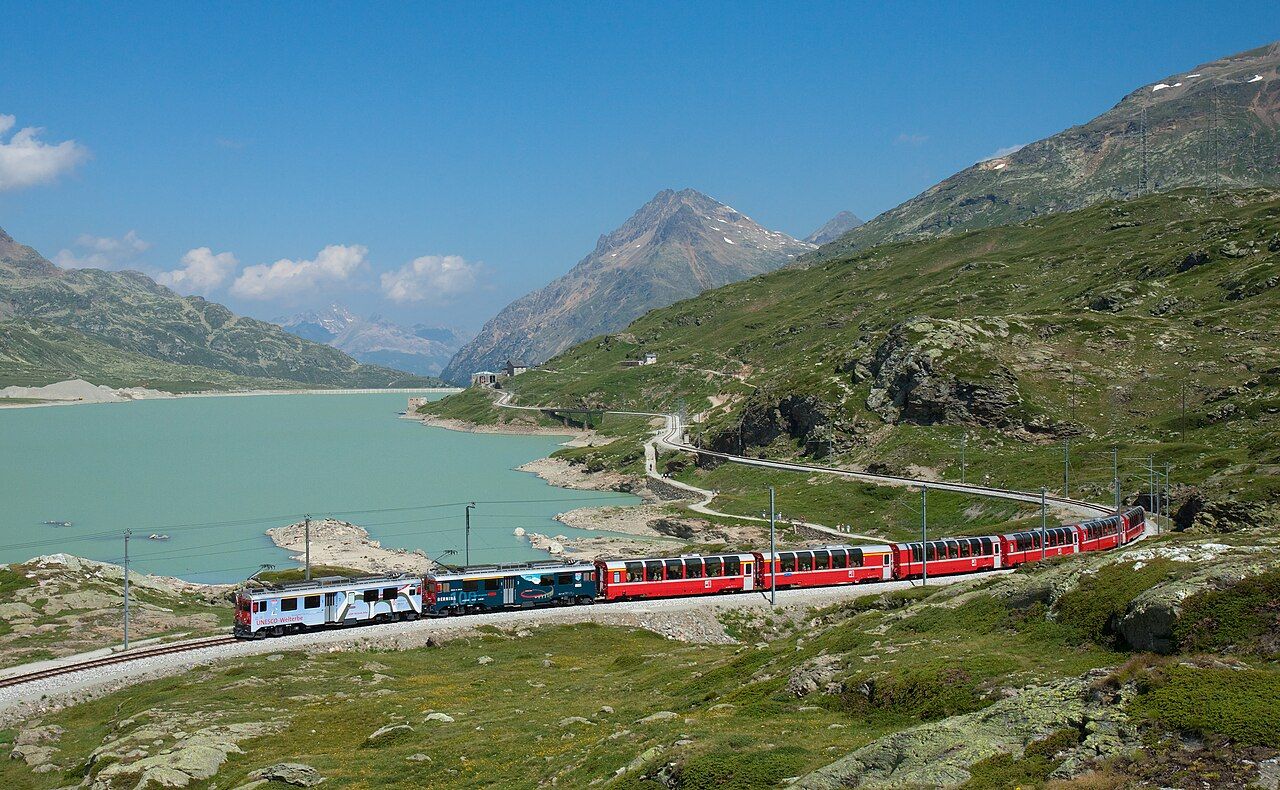
At St Moritz, the Bernina line begins its run towards Italy. The train climbs, and the route gives its argument early. This is a railway made interesting by the work it does. No rack helps it over gradients of up to 7 per cent. That fact is more persuasive than any grand claim about scenery. The line opened in 1910, and its purpose remains plain.
There is a satisfying directness to travelling this way. The distance is about 61 km, but the climb changes the scale. The railway moves between St Moritz and Tirano without needing a long itinerary around it. Its best moments are not all vast views. The engineering matters just as much, and sometimes more. I prefer a route with something to explain beyond its appearance.
Ospizio Bernina marks the highest point of the line, at 2,253 m. That number gives the journey a firm centre. The train has climbed to a clear summit, rather than merely passing through attractive country. It is a useful distinction. Many railway journeys offer scenery; fewer make the work of reaching it this legible. Here, the gradient is part of the story, not background detail.
From Alp Grüm, the train looks across to the Palü Glacier. This is the view most likely to hold attention. The railway gives the glacier a place in the journey, rather than making it the whole point. That balance suits the line. A view can be memorable without carrying every minute around it. I would rather have one distinct outlook than a sequence of scenery described as equally wonderful.
The numbers: about 61 km; about 2.5 hours; by train. That is enough time for the route to feel substantial, without turning the journey into an endurance test. The short distance is part of its appeal. There is a beginning at St Moritz, a high point at Ospizio Bernina, and an arrival at Tirano. The route has a shape, not just a list of stops.
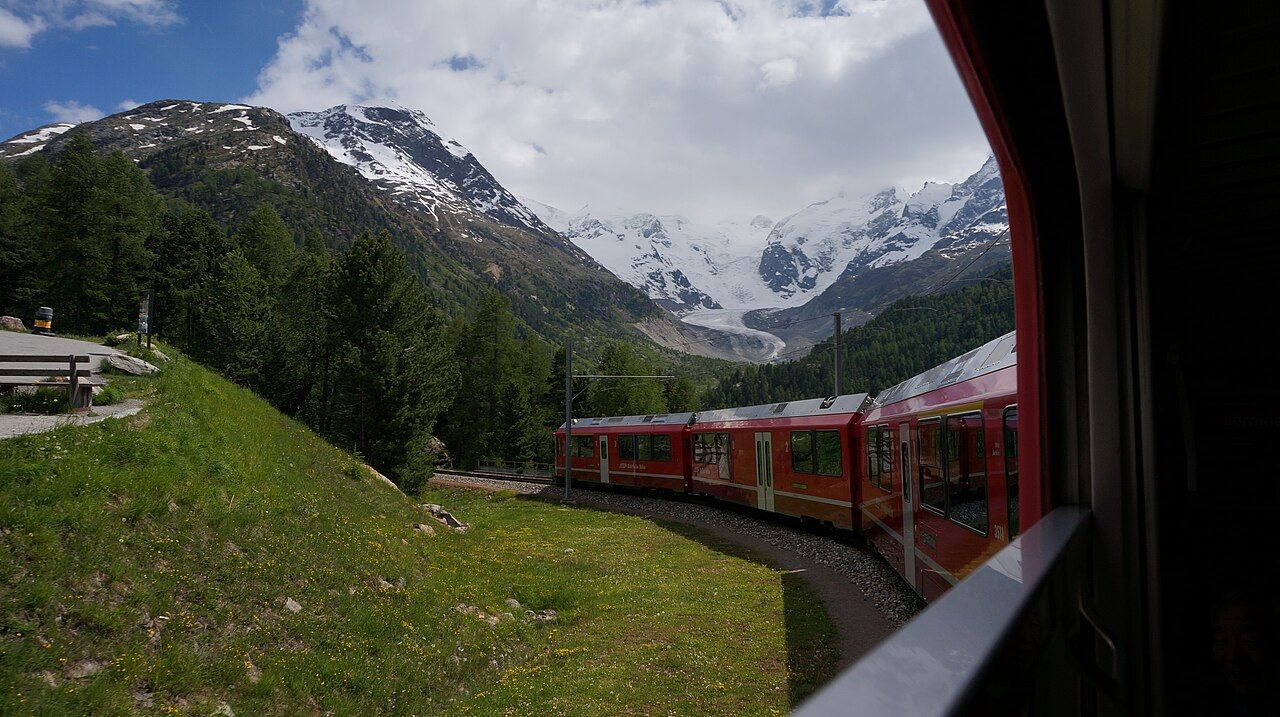
The descent
Near Brusio, the line turns a full circle on a stone spiral viaduct. It is a clear piece of railway theatre, though the engineering is the real attraction. The circle makes the route visible as a problem solved. A train has to lose height; here, the line turns that necessity into a form worth looking at. It is hard not to favour a structure that explains itself.
The line's best argument is how little engineering it asks passengers to admire. The railway climbs gradients of up to 7 per cent without a rack, then uses the spiral viaduct near Brusio. These are not separate curiosities. They are parts of one practical answer to difficult ground. The result is a journey whose scenery has a strong supporting cast. The railway itself deserves the attention.
There is room for comparison, though not much need for ranking. The long Swiss line from Zermatt belongs to a different sort of railway conversation. For walking, the Dolomites high route makes a useful contrast. And India's toy train to Darjeeling points towards another railway with its own character. The Bernina line does not need borrowed glamour. Its appeal is already specific: height, gradient, glacier and spiral.
The Albula and Bernina lines were inscribed together as the Rhaetian Railway in the Albula / Bernina Landscapes in 2008. The shared recognition suits a railway whose identity depends on more than one celebrated viewpoint. Still, Alp Grüm and Brusio remain the clearest anchors here. One looks towards the Palü Glacier; the other turns a full circle. Those details are easier to carry away than a broad claim about a whole landscape.
A thermos of tea is my preferred companion for a journey with this much to watch. It asks for no elaborate plan, and it leaves attention free. The line provides enough structure on its own: a climb, a high point, a glacier view, then the circle near Brusio. I would not pad the trip with extra ceremony. The pleasure lies in watching the route make its case, plainly.
Timetables and route maps for the narrow-gauge network are published at rhb.ch. That is the useful practical detail, without disguising the journey as a complicated undertaking. The line's length and usual time are easy to hold in mind. Its appeal does not depend on squeezing in more. It works because the railway keeps changing the view while remaining a coherent route from St Moritz to Tirano.
At Tirano, the railway reaches the foot of the line, in the Valtellina in Italy. The climb is finished, and the journey has become a simple line in memory. St Moritz, Ospizio Bernina, Alp Grüm, Brusio, then Tirano: enough landmarks, and no need to inflate them. I would take the Bernina line for its engineering first, and its views close behind.
The line's best argument is how little engineering it asks passengers to admire.