Mountain & Coast Paths
The Laugavegur: Colour, Obsidian and Black Sand
A 55 km walk from coloured rhyolite to black sand, with glacial rivers to ford and an eruption-shaped extension beyond Þórsmörk.
- Length
- about 55 km
- Usual time
- 3-4 days
- Travelled
- on foot
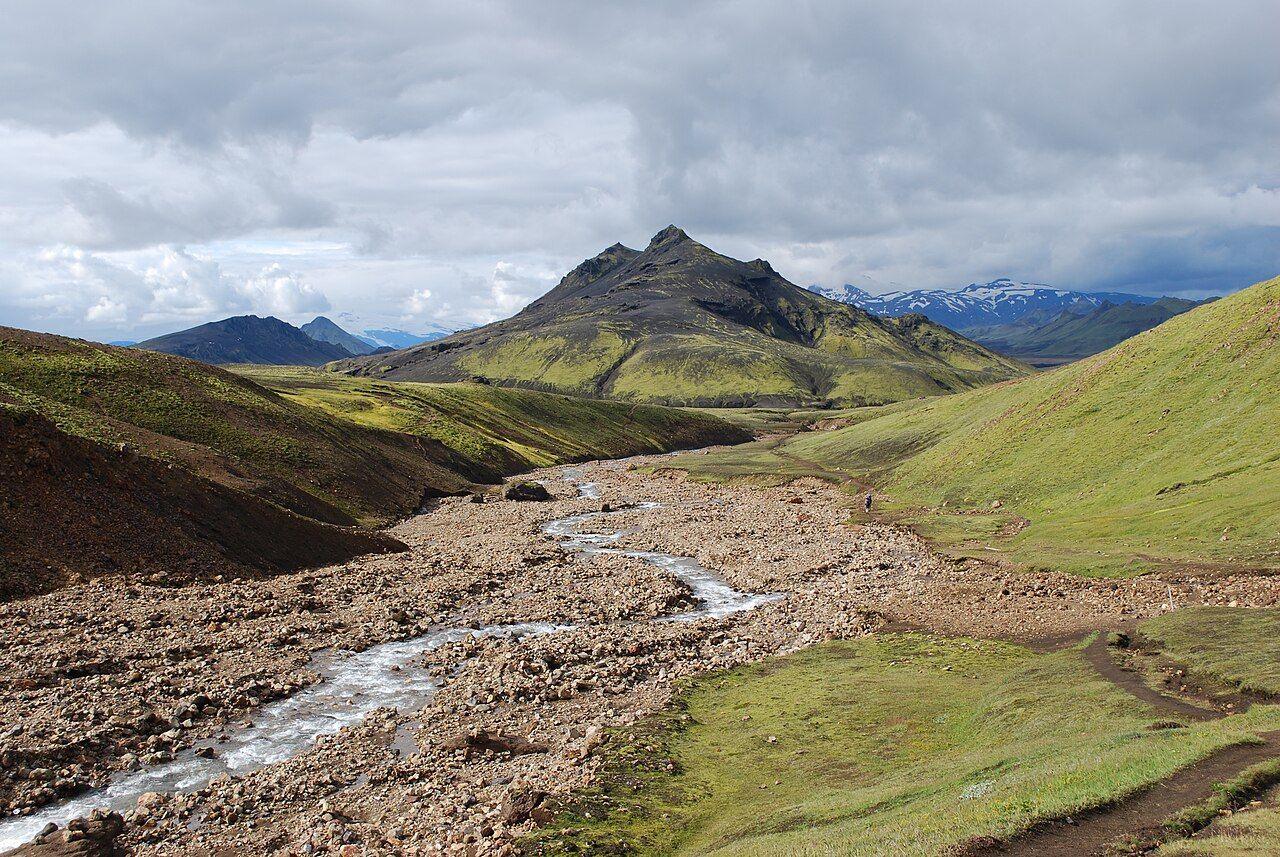
About 55 km runs from Landmannalaugar to Þórsmörk. That is enough distance for the landscape to change its terms. The Laugavegur is best read as a sequence of contrasts.
Landmannalaugar opens with rhyolite mountains streaked red, yellow and green. That colour is the walk’s strongest opening argument. Walkers also bathe in natural hot springs at Landmannalaugar. It is a generous beginning, but not the whole case.
Hrafntinnusker, on the first stage, takes its name from black obsidian found there. That is a better detail than another broad promise of scenery. The southern stages change the texture again. Black sand and glacial rivers make the walking more demanding. Those rivers are forded on foot, which keeps the route honest. A thermos of tea sounds particularly welcome beside that effort.
The trail is generally open from late June to early September. That is a clear window, and a useful fact.
The numbers: about 55 km; 3-4 days; on foot.
I like setting this walk beside other kinds of journey: a train over the Hardangervidda, the road to Nidaros, and the GR20's two halves. The comparisons matter less as rankings than reminders that each route needs its own character.
From Þórsmörk, the Fimmvörðuháls pass continues the walk to Skógar. The extension changes the ending from valley to volcanic ground. At Fimmvörðuháls, the 2010 eruption created two new craters. They are named Magni and Móði, concise names for striking landmarks. That is a strong reason to continue, though the Laugavegur already has a complete shape. Colour, obsidian, black sand, rivers and valley make a satisfying sequence. The pass is a distinct continuation, with its own volcanic account.
The best part is the contrast, not a single grand view. I like the closing picture: black sand behind, a thermos of tea held close, and Þórsmörk ahead.